7 Ways to Detox Your Emotional Well Being

“Emotional health is an important part of overall health. It means you are aware of your emotions. You can deal with them, whether they are positive or negative. Emotionally healthy people still feel stress, anger, and sadness. But they know how to manage their negative feelings. However, burnout is a real thing too. In this video, we share 7 ways you can detox your emotional well being. Hope you find these tips helpful! Share it with someone who might need this.” – Writer: Catherine Huang, Psych2Go

Psych2Go “hopes to raise awareness about mental health and create a safe space that allows for open communication to those who are struggling in life, so we can learn to cope together.”

See: https://psych2go.net/

6 Habits That Destroy Your Emotional Well-Being

“Emotional well-being refers to the emotional quality of our experiences… Stressed out and overwhelmed? Not sure if you’re falling into bad habits that hurt you and destroy your chances of finding lasting contentment? These habits tend to fly beneath our radars because we’re unaware of the damage they do to our mental health, such as the increased risk of depression and anxiety. So, to help you take your power back and stop this negative cycle, we’ve made this video to help you recognize some of the habits that may destroy your emotional wellbeing.” – Writer: Michal Mitchell, Psych2Go

Psych2Go “hopes to raise awareness about mental health and create a safe space that allows for open communication to those who are struggling in life, so we can learn to cope together.”

See: psych2go.net

Suicide Prevention and Mental Health Crisis Hotline

NAMI, the National Alliance on Mental Illness, reminds us, “One call can save a life. But when a person in a mental health crisis has to find a local phone number or a ten-digit Lifeline number, precious minutes—and even the resolve to get help—can be lost.”

That’s why NAMI and others are advocating for an easy-to-access 3-digit emergency number (9-8-8) to help people in a mental health crisis. NAMI is the nation’s largest grassroots mental health organization dedicated to building better lives for the millions of Americans affected by mental illness.

every minute counts

On May 13, 2020, the U.S. Senate unanimously passed S. 2661, The National Suicide Hotline Designation Act, to establish 9-8-8 as a nationwide hotline for suicide prevention and mental health crises—making it easier for people in crisis to receive immediate and appropriate mental health support. Now, the U.S. House of Representatives needs to pass this important measure. Click here to support this effort.

Although 9-8-8 is not currently available [UPDATE: 988 became available on July 16, 2022.], if you or someone you know is experiencing a mental health crisis, help is available now. Call the Suicide Prevention Lifeline: 1-800-273-8255. The National Suicide Prevention Lifeline is a national network of local crisis centers that provides free and confidential emotional support to people in suicidal crisis or emotional distress 24 hours a day, 7 days a week.

COVID-19 Advocacy

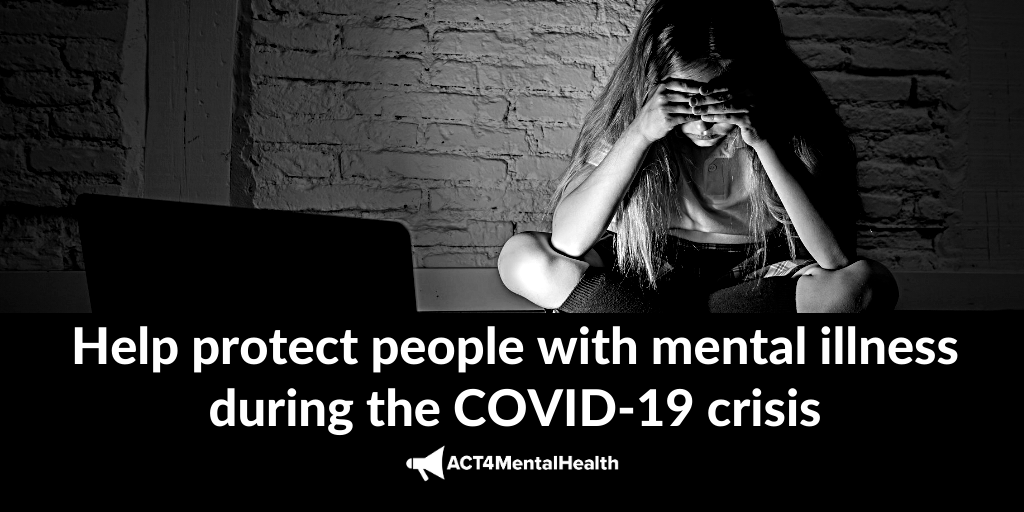
COVID-19 Advocacy: Help people with mental health conditions
Covid-19 Crisis

During the COVID-19 crisis, NAMI (National Alliance on Mental Illness), a nonpartisan organization, is asking the public to support their effort to convince the U.S. Senate to:

1. Remove barriers to mental health treatment. People need ways to manage existing mental health conditions and maintain mental wellness while reducing their exposure to the coronavirus. To do this, Congress should:

• Eliminate all barriers to widely implementing telehealth in all public and private health plans and encourage all health plans to provide extended supplies and/or mail order refills of prescriptions. Both actions will help people with mental illness avoid risk of exposure to COVID-19.

• Approve funding for Emergency Response Grants at the Substance Abuse and Mental Health Services Administration (SAMHSA) to assist states in continuing to provide treatment for people with mental health conditions and substance use disorders.

2. Promote coverage for health and mental health care. People with mental health conditions are often uninsured or face barriers to getting needed treatment and supports. These challenges are even greater during a crisis. To address this, Congress should:

• Immediately launch a special enrollment period for commercial health insurance in the Marketplace (HealthCare.gov) to make sure people have access to affordable, quality health care coverage.

• Require the use of “presumptive eligibility,” which allows certain providers like hospitals and clinics to enroll people in Medicaid that they believe meet eligibility criteria.

• Ensure free COVID-19 testing and treatment for everyone, including people who are uninsured.

3. Ensure safe housing for people with severe mental illness. Many people with severe mental illness experience homelessness or housing insecurity and are uniquely vulnerable to being exposed to the virus and outbreaks in shelters or encampments. With the loss of steady income, many more individuals are also at risk of losing housing. Congress must act by:

• Providing $5 billion to serve people who are homeless and help them stay safe and healthy during this emergency.

• Approving an additional $5 billion to provide rapid rehousing for people who are at immediate risk of becoming homeless and funding for rental assistance to help low-income renters weather this crisis.

• Putting a temporary stop on evictions to ensure that renters and homeowners maintain stable housing during this crisis.

4. Support nonprofits’ capacity to serve. The economic impact of this crisis will also touch charitable organizations like NAMI organizations and our partners. Nonprofits need support to meet greater demand and fill important gaps during this time. To assist, Congress should:

• Provide targeted assistance to 501(c)3 organizations to help them keep their doors open during this crisis and offer paid leave to their employees.
College Students and Mental Health Help

The Associated Press has published an article under the headline, “As stigma ebbs, college students seek mental health help.”

Here’s an excerpt:

“More college students are turning to their schools for help with anxiety, depression and other mental health problems, and many must wait weeks for treatment or find help elsewhere as campus clinics struggle to meet demand, an Associated Press review of more than three dozen public universities found.

On some campuses, the number of students seeking treatment has nearly doubled over the last five years while overall enrollment has remained relatively flat. The increase has been tied to reduced stigma around mental health, along with rising rates of depression and other disorders. Universities have expanded their mental health clinics, but the growth is often slow, and demand keeps surging.

Long waits have provoked protests at schools from Maryland to California, in some cases following student suicides. Meanwhile, campus counseling centers grapple with low morale and high burnout as staff members face increasingly heavy workloads.”

Read the article: https://apnews.com/08e5c195bf04471e9c4a127abe831d91

How to Test Your Emotional Maturity

“Knowing how emotionally mature someone is can be the most important thing to know about them; but this knowledge may take (painful) years to acquire. This is why we’ve devised a very quick and very reliable test that can – in a few minutes – help us to ascertain our own and other people’s level of emotional maturity. It all has to do with how one responds to vulnerability.” – The School of Life in London

“One of the more puzzling aspects of the way we’re built is that our emotional development does not necessarily or automatically keep pace with our physical growth. We can be fifty-five on the outside and four and a half in terms of our impulses and habitual manner of communicating – just as we can be on the threshold of adulthood physically while an emotional sage within.

In order to assess our own and others’ emotional development, we can make use of a single deceptively simple question that quickly gets to the core of our underlying emotional ‘age’.”

Three cardinal virtues of emotional maturity: Communication, Trust, and Vulnerability.

Video: 6 minutes

Comedians Tackling Depression & Anxiety

“Laughing Matters is a 30-minute documentary that brings comedians together for an honest look and real conversations about comedy + mental health because when the cost of bringing others joy is your own joy…the cost is too high.”

This is a SoulPancake production in association with Funny Or Die and Alpen Pictures.

If you’re struggling, text HELLO to 741741 or call 1-800-273-8255.

Backline – Wellness Hub for Music Industry

Backline - Wellness Hub for Music Industry

Backline, a new mental health foundation and a collective effort of the music industry, has been formed to raise awareness and provide easy access to mental health resources for performers and professionals in the music industry.

The project will begin as a “referral-based system, where [mental health] professionals will assess visitors’ needs and lead them to appropriate resources. Backline’s goal is to provide a network of on-demand mental health services available at no (or low) cost for industry professionals, with a focus on addressing the unique challenges and stresses of our space.”

In addition to its online space, Backline will also provide a backstage resource for performers at events who may find themselves in distress.

For more information, see:  https://backline.care/

Project CommUNITY: Shining Light on Mental Health

At the beginning of this year (2019), officials in New Hampshire released a blueprint for how the state plans to address the mental health crisis for the next decade.

See coverage of the 10-year plan on WMUR-TV in Manchester, New Hampshire:

     https://www.wmur.com/article/new-hampshire-implements-10-year-mental-health-plan/29254050

     https://www.wmur.com/article/10-year-mental-health-plan-aims-to-improve-services-in-nh/29251763

View Part 3 of the WMUR Project CommUNITY special, “Shining Light on Mental Health” (12 minutes 37 seconds)

See the transcript for Part 3:

https://www.wmur.com/article/project-community-shining-light-on-mental-health-part-3/29255860

View Part 6 of the WMUR Project CommUNITY special, “Shining Light on Mental Health” (3 minutes 4 seconds)

See the transcript for Part 6:

https://www.wmur.com/article/project-community-shining-light-on-mental-health-part-6/29255920

View Part 1 (14 minutes 19 seconds):

     https://www.youtube.com/watch?v=Ik3_1Fx1luM

     https://www.wmur.com/article/project-community-shining-light-on-mental-health-part-1/29255928

View Part 2 (7 minutes 46 seconds):

     https://www.youtube.com/watch?v=aecxSzDH1IM

     https://www.wmur.com/article/project-community-shining-light-on-mental-health-part-2/29255834

View Part 4 (4 minutes 9 seconds):

     https://www.youtube.com/watch?v=OJQRBFzTDdE

     https://www.wmur.com/article/project-community-shining-light-on-mental-health-part-4/29255901

View Part 5 (3 minutes 221 seconds):

     https://www.youtube.com/watch?v=wf63vD6DmvM

     https://www.wmur.com/article/project-community-shining-light-on-mental-health-part-5/29255909